First Step: What Do You Want Your System To Do
If you're considering getting or upgrading a home stereo or home theater system, your first step should be to determine how you want the new system to work.
GENERAL HOME STEREO AND THEATER DISCUSSIONS
5/17/2026
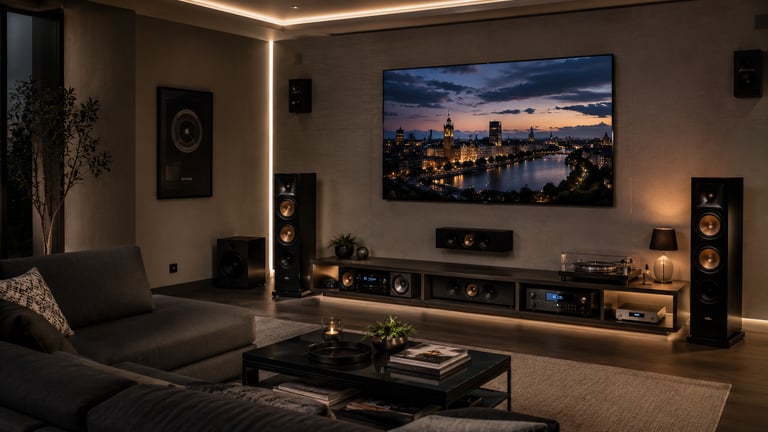
The very first thing that I’d advise doing before looking at specific speakers, receivers or services is to figure out what you want your ideal system to do and how you want to interact with it. I’ll provide a brief overview of the landscape today, as I see it, and plan to go into more depth in additional posts targeted for specific topics.
And I’ll give this caveat here: Most everything about sound reproduction, whether music or movie and video soundtracks, is highly subjective. Not only do we all have different ears and won’t hear things exactly the same (in terms of sound quality), we also all have a different appreciation for different aspects of the sound. For example, some people prefer a sound that’s highly transparent while others prefer a warmer sound that they feel elicits a more emotional response.
Music Only System
At the most basic, a system targeted only for music still has options to consider. There are many considerations in terms of music format, how the music is accessed, ease of use and the user interface. There are also considerations about the technologies used for the equipment, from different approaches to speaker design to different amplification approaches, conversion of digital music information to the analog signal your speakers will output and even the question of the level of integration of the various components in the signal chain.
I've assembled some recommendations for stereo systems to address both analog and digital sources.
Analog or Digital?
For well over a century, the primary means of listening to music in the home was through analog records. Dragging a needle across dips and crevasses in a vinyl disk in many ways seems incredibly out dated with the new technologies available, but not only do many “audiophiles” still prefer this medium, it has been experiencing quite a resurgence the last few years with the general public as well. Many claim that records provide a much more natural and musical experience than even the best digital music reproduction. There’s also an enjoyment many have with the ritual of putting on a record, cleaning it with a record brush, dropping the needle to the record and sitting back and listening while reading the liner notes on the album cover.
When I discuss analog music, my discussions will be limited to vinyl records. The only other meaningful analog sources have been reel-to-reel tape, cassette tape and 8-track tapes, none of which are significantly popular today, as well as broadcast radio. Reel-to-reel tape can provide the best possible analog sound, but finding good performing tape decks at a reasonable price is incredibly difficult and high quality pre-recorded tapes are scarce, the selection is very limited and what’s available is very expensive. There is a modest resurgence of cassette decks and tapes, but it’s not very significant yet. Analog radio broadcasts are not a major concern for most people in their homes today, especially since many streaming services are available to listen to digital radio stations from around the world.
Digital music, on the other hand, offers a wide variety of sources and ways to access it. At it’s simplest it comes in the form of CD’s (or more rarely, Super Audio CD’s – SACD’s). Then there are the computer files, whether downloaded from an online store to your local computer or hard drive or streamed across the internet via one of the many streaming services available today, including internet radio as mentioned before. The greatest advantage of streaming services is that you get access to an enormous music collection – far more than anyone can acquire with physical media and at a much more affordable price, albeit a recurring subscription price. You can more easily create playlists for different situations than when we crafted them with records and cassettes. Personally, I often playback my playlists in a shuffle mode, rather than playing them straight through so that the order when I add songs to the playlists doesn’t really matter for me.
Video and Music Systems
Many, if not most people want to have a system that combines an enjoyable experience while watching video (including movies, sports and TV) as well as excellent music reproduction. Video sources can include a wide variety of sources, including the multiple streaming platforms, cable TV, DVD and Blue Ray discs, broadcast TV and gaming consoles.
There are many considerations in these “home theater systems”. For the viewing screen itself, there’s the choice between a traditional TV or a projector, and then between the display technology (such as LED vs OLED, and the current technologies available to give the best display possible, and the differences between high definition formats such as HDR10, HDR10+ and Dolby Vision). 8K TV’s and compatible home theater receivers are available now, but 8K sources are not currently a concern.
My focus here will be primarily on the sound reproduction of these systems, as well as their integration into a comprehensive entertainment system. Two primary concerns in this area are the extent of surround sound immersion and the components available and how they integrate. I also have recommendations for home theater systems for you.
Sound Formats
While currently available TV’s offer stereo speakers, and some have technology to simulate surround sound immersion to some extent, external speakers and amplification will provide a much richer sound experience. But before looking at speakers and the source it’s important to determine the extent of sound immersion you want.
Note: Subwoofers can be used for any of these setups. I’ll discuss these as a separate topic.
Stereo only
Many people are completely satisfied with a stereo only sound setup for their movies, video and sports viewing. I include myself in this camp, having downsized from a 5.1.4 surround setup as I wanted to simplify my environment. While this obviously eliminates the surround effect of rear, side and overhead speakers, my initial main concern was dialog clarity. Without a traditional center channel speaker, dialog is handled by a “phantom center” image from the left and right speakers. Interestingly, I achieved much better dialog reproduction by putting my video processor into stereo mode than when I altered the speaker configuration in the setup menu to simply remove the center speaker. I found that I truly didn’t miss the surround effects in action movies.
Having a stereo only setup also provides more budget for the two speakers, rather than spreading the budget to get 5 or more speakers for a surround or ATMOS setup.
Surround Sound and ATMOS
There’s no denying that having a surround sound setup, whether or not it extends to an ATMOS setup, can provide an incredibly rich and immersive experience (especially for action movies). You can get the thrill of hearing that jet (or space ship) thundering over your head and behind you. Having a dedicated center channel can also anchor the dialog to the viewing area, particularly if your seating includes people viewing the video from wide angles. The simplest setup is 5 speakers with a front left and right speaker, a center channel speaker, and two surround speakers. To this you can add side speakers, front and rear height speakers and even overhead front and rear speakers for an ATMOS setup.
Another consideration is that ATMOS encoded music has started to be available in the last few years. In my opinion this is still an evolving format, though, and I’m not sure of its durability as a format for music. A music experience is different from a movie experience. We typically sit in front of the musicians and the music all comes from that direction, rather than sitting in the middle of the musicians and surrounded by it. I tried some examples of ATMOS music (for example, an ATMOS encoded Blu Ray disc of Abbey Road by the Beatles, and Dark Side of the Moon by Pink Floyd). I believe sound engineers are still experimenting with how to mix tracks for ATMOS to achieve something that really enriches the music as opposed to interesting gimmicks, like having a sound swoop around you. Those old enough to recall experiments with quadrophonic music in the 70’s will remember that that format never really caught on either.
Going Beyond
An important consideration, and one with unprecedented options until fairly recently, is to what extent you’d like these visual and audio experiences to be integrated into your home environment. Today there are many options to distribute music and video throughout your home, as well as being able to incorporate smart home features like lighting control. With these options you can have the same music or video content playing in different rooms in your home or have your shades close and lights dim when you start a movie.
Today there are more options than ever before for getting the most out of our home entertainment systems. Whether your interest is in an excellent sounding stereo setup for music, being able to stream music in multiple rooms (and even your workshop and back yard), an immersive environment for your movie and sports watching, or even to access your stored media when away from home there is a huge range of equipment and systems available to make that happen for you.
As an Amazon Associate I earn from qualifying purchases
©copyright 2026 Sound Invested. All rights reserved.
Contact: support@soundinvested.com